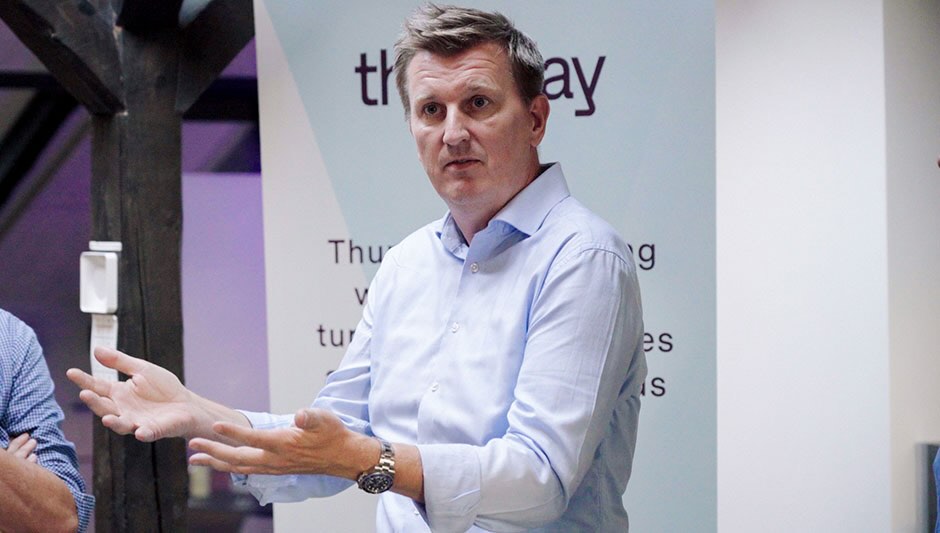
At Thursday Consulting's panel debate on the future of core systems on 3 September 2026, our CEO Sune Dyrlund Aagaard set a target of one year for implementing a new core system. Here's what it takes to get there.
The idea that replacing an insurance core system takes three to five years is so widespread that it's rarely challenged. A core system is the heart of the business, and replacing it is a project that can't be allowed to fail. That's why long timelines have traditionally felt like the safe choice.
On the panel, Sune set a different target:
'My goal is that you can replace your core system within a year. It shouldn't take any longer.'
The difference between one year and five is about more than time. For as long as the replacement is under way, the old system keeps running alongside the new one, key people have to juggle day-to-day operations and the project, and new products and automation are left waiting to go live. It costs not just money but your people's capacity – and with it, everything the business doesn't get done while the implementation is running.
But one year is a claim that deserves a proper explanation. Here it is.
Standardisation over customisation
Long projects are rarely down to the technology alone. They're just as much down to the approach to implementation.
'Insurance is insurance, with respect for the fact that every company has its own niche. But there are a lot of fundamentals that are shared,' says Sune Dyrlund Aagaard.
That's the approach we brought with us from claims to policy. Scalepoint ClaimsCORE is built on best practice from a wide range of insurers, and with Scalepoint PolicyCORE we're doing the same on the policy side. Together they make up Scalepoint CORE: one core system that covers the entire insurance process, from policy to claim.
The solution is implemented by configuring shared functionality – not by building far too much from scratch every single time. It's also delivered as SaaS, so every insurer runs on the latest version, and upgrades happen automatically every week, so they stop being projects in their own right. The same goes for compliance and security: we update the platform once, and every insurer gets the change.
The core – and everything around it
A core system doesn't solve anything on its own, though. That's why we let insurers choose a complete core solution with policy, claims and finance, as well as customer-facing portals, country layers and specialised solutions for motor, property and health, among others.
These are options, not requirements. If an insurer only wants the core and prefers to build its own portals on top of our APIs, that's a perfectly viable route. But we see good reason to offer the portals:
'We get around the industry, and we don't see many good CRM solutions, for example. So companies implement Salesforce or Dynamics, but they're not designed for insurance. Then all sorts of customisations are made, which means the software can't be updated afterwards. It gets expensive.'
What nobody should differentiate on
Another concrete example is integrations with shared industry solutions such as F&P (Insurance & Pension Denmark) and DMR (the Danish Motor Register).
'In my view, it's foolish that every insurer sits and does the same job of integrating with F&P and DMR. In the solution we're bringing to market, it's included and ready. You should differentiate on products, prices and the customer journey. The rest is just things that need to work.'
AI in two places, not one
The debate also touched on who should be at the forefront of technology: the vendor or the insurer. We believe the expectation lies with the vendors.
'We don't have to invent everything ourselves. We need to be good at finding partners and having open APIs, so data gets to where insurers need it,' says Sune Dyrlund Aagaard.
But AI isn't only about what users encounter in the solution. It's just as much about how the system is developed. We're already using AI in our development work, and we're aiming for a significant efficiency gain over the coming year. It isn't visible to customers, but it ties directly to the one-year target: the more ready-made functionality there is when a project starts, the less needs to be built along the way.
The long and short of it
One year isn't a promise that everything becomes easy. It's an expression of what becomes possible when you stop building the same thing over and over: standardised modules already running at other insurers, industry integrations that come included and a platform that updates automatically.
That leaves insurers free to spend the rest of their time on their products, pricing and customer journeys – the things they actually compete on.
A look at the evening when Thursday Consulting brought the industry together to debate the future of core systems on 3 September 2026.